
Prime Minister Instructs Government to Ensure Targeted Provision of Social Assistance
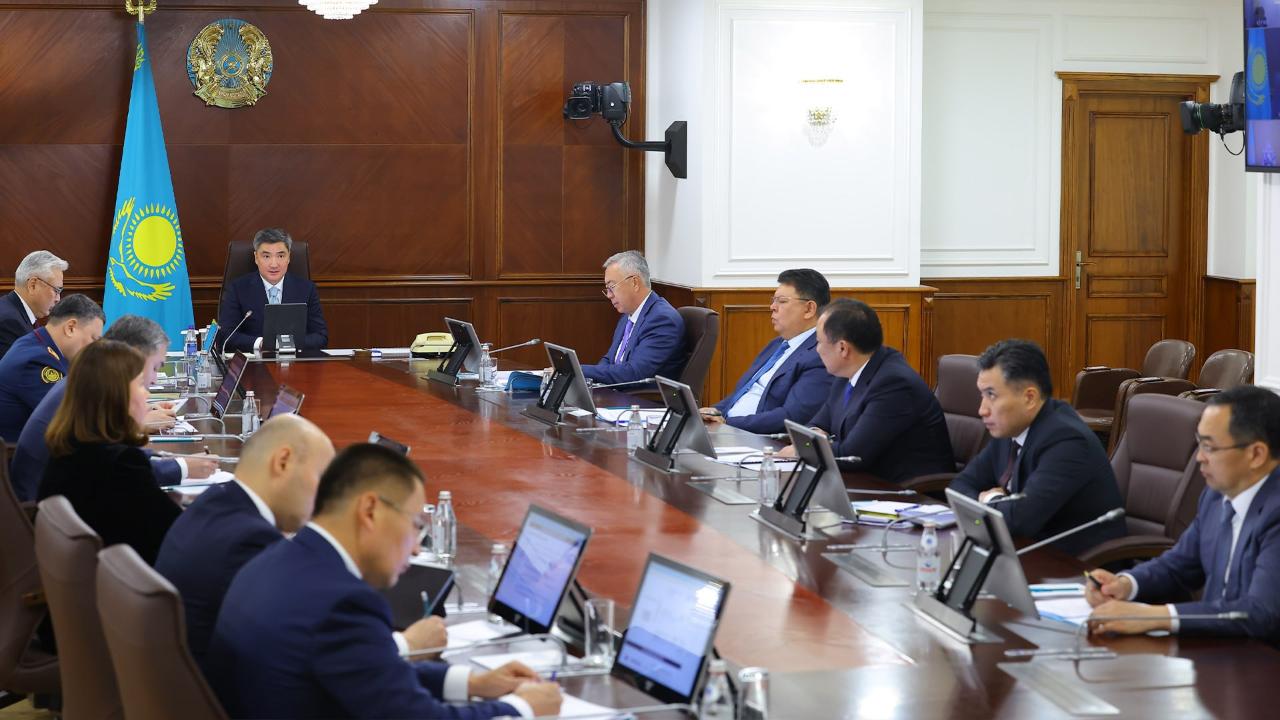
Prime Minister of the Republic of Kazakhstan Olzhas Bektenov chaired a meeting on the implementation of the instructions issued by Head of State Kassym-Jomart Tokayev on 19 September during the nationwide environmental campaign Taza Qazaqstan.
“As the Head of State noted, our country has entered an era of large-scale transformation. The new Constitution opens up new opportunities for the further development of an Advanced Kazakhstan. Major reforms are already being implemented across all areas.
Most recently, Kassym-Jomart Kemelevich Tokayev set a number of tasks for the Government concerning the provision of social assistance to citizens, the development of a strong environmental culture, ensuring the highest possible quality of urban roads and roads of national significance, and the wider application of the experience of the Astana Urban Centre,” Olzhas Bektenov said.
The Prime Minister heard reports from the ministries on progress in implementing the President’s instructions in the relevant areas.
“As the President noted, the state consistently fulfils its social obligations. At the same time, it is important to ensure that necessary social assistance is provided only to citizens who genuinely need it. Ministers and akims must undertake extensive work in all the areas identified. Citizens should be widely informed about the types of assistance available. Regional akimats must strengthen their awareness-raising activities among recipients of social allowances,” the Prime Minister said.
Targeted Provision of Social Assistance
As part of the implementation of these instructions, Minister of Labour and Social Protection of the Population Askarbek Yertayev reported on measures relating to the provision of social assistance and benefits to citizens.
According to the Ministry, the first stage involves establishing the regulatory framework for the transition to a targeted model of state support based on the principle that “assistance should be provided to citizens who genuinely need it”. This stage covers 14 of the 36 types of social payments.
At the second stage, 13 types of social assistance provided by local executive bodies will be consolidated into four types, depending on the level of need. Proposals were also presented to introduce targeted state support for veterans based on the principle of need from the beginning of 2027.
The meeting also considered the appropriateness of providing childcare leave to men, as well as the possibility of improving forms of support for women during the two-year childcare period by increasing the availability of places in nurseries and kindergartens and addressing the shortage of carers for young children.
The results of introducing artificial intelligence tools into the process of providing assistance to persons with disabilities were also presented. In particular, 167 cases were identified in which disability had been established using falsified medical documents, and the relevant materials were referred to law enforcement authorities. In addition, 18,647 cases were identified in which identical data appeared in the records of different individuals. Work in this area is ongoing.
The reforms described above will apply to recipients of state support who, according to the Digital Family Card system, fall within welfare categories “A” — high level — and “B” — satisfactory level.
As part of this work, akimats are conducting surveys of citizens through the Digital Family Card information system. From 1 October this year, citizens will gradually begin to receive information about changes to the conditions for the assignment of social payments via SMS, the eGov Mobile application and banks’ mobile applications.
Legislative amendments have been developed in relation to all of the above proposals and will be submitted to the Qurultay for consideration.
Prime Minister Olzhas Bektenov instructed the Ministry of Labour and Social Protection of the Population, together with regional akims, to coordinate efforts to ensure the targeted provision of social assistance and allowances.